


Key Highlights
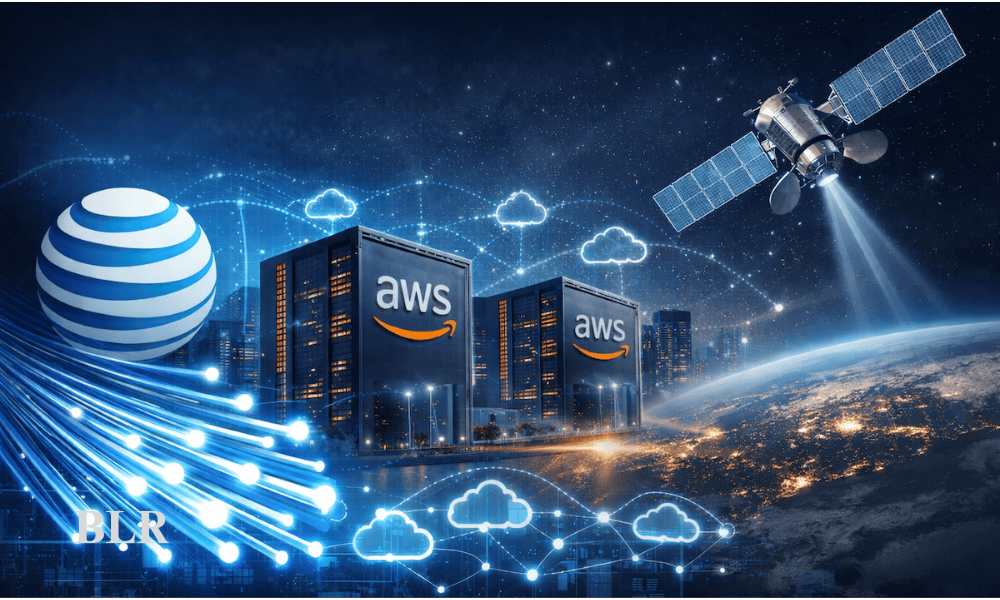
- AT&T and AWS are combining fiber, satellite, and cloud infrastructure to enhance enterprise connectivity.
- The partnership focuses on hybrid cloud modernization and data center transport.
- High-capacity fiber will support large-scale AI workloads.
- Low Earth Orbit (LEO) satellite connectivity will extend broadband reach to remote locations.
AT&T has announced a strategic collaboration with Amazon Web Services (AWS) to integrate its fiber and satellite networks with AWS cloud infrastructure. The move is aimed at improving enterprise connectivity coverage, network performance, and operational efficiency across the United States.
The partnership reflects a growing industry trend where telecom operators and hyperscale cloud providers are working more closely to manage increasingly complex network environments and unlock new revenue opportunities in underserved locations.
Hybrid Cloud to Improve Operational Efficiency
As part of the agreement, AT&T is migrating workloads from legacy on-premises systems to AWS Outposts, a managed hybrid cloud solution that allows AWS infrastructure to run within AT&T facilities. This transition is designed to speed up internal updates, improve resilience, and modernize network operations.
To support the migration, AT&T is working with AWS Professional Services and using Amazon Q Developer to accelerate the enablement of network services. The use of generative AI tools highlights how large-scale infrastructure modernization is increasingly dependent on AI-assisted development to meet deployment timelines.
Fiber Infrastructure to Power AI Workloads
Beyond internal modernization, AT&T will connect AWS data centers using high-capacity fiber networks. This infrastructure will support cloud services for enterprises deploying advanced AI and data-intensive applications that demand low latency and high throughput.
Shawn Hakl, senior vice president of product at AT&T Business, said fiber is the foundation of future connectivity, delivering the speed, reliability, and scale required by modern networks. By combining fiber expansion with AWS cloud capabilities, the companies aim to create a more resilient and intelligent connectivity ecosystem.
Expanding Reach With Low Earth Orbit Satellites
The collaboration also includes non-terrestrial connectivity through Amazon’s Low Earth Orbit (LEO) satellite network. AT&T plans to use this capability to offer fixed broadband services to businesses operating in areas beyond the reach of traditional terrestrial networks.
LEO satellite integration allows enterprises with distributed or remote assets, such as logistics hubs or industrial sites, to operate under a single service-level agreement, reducing complexity and improving network reliability.
What Next?
According to Jan Hofmeyr, vice president of telecommunications at AWS, the partnership benefits both sides: AT&T gains access to AWS cloud and AI tools to modernize its infrastructure, while AWS leverages AT&T’s fiber networking expertise to enhance data center connectivity.
The deal underscores how the line between cloud providers and telecom operators continues to blur. As enterprise digitalization accelerates, the ability to seamlessly integrate fiber, satellite, and hybrid cloud infrastructure will be critical to supporting next-generation connectivity and AI-driven services.