


In the LegalTech industry, innovation often arrives wrapped in bold promises. Yet few companies are willing to tackle one of the most technically complex, financially sensitive, and compliance-heavy workflows inside a law firm: cost drafting. Automate Legal has chosen precisely that challenge.
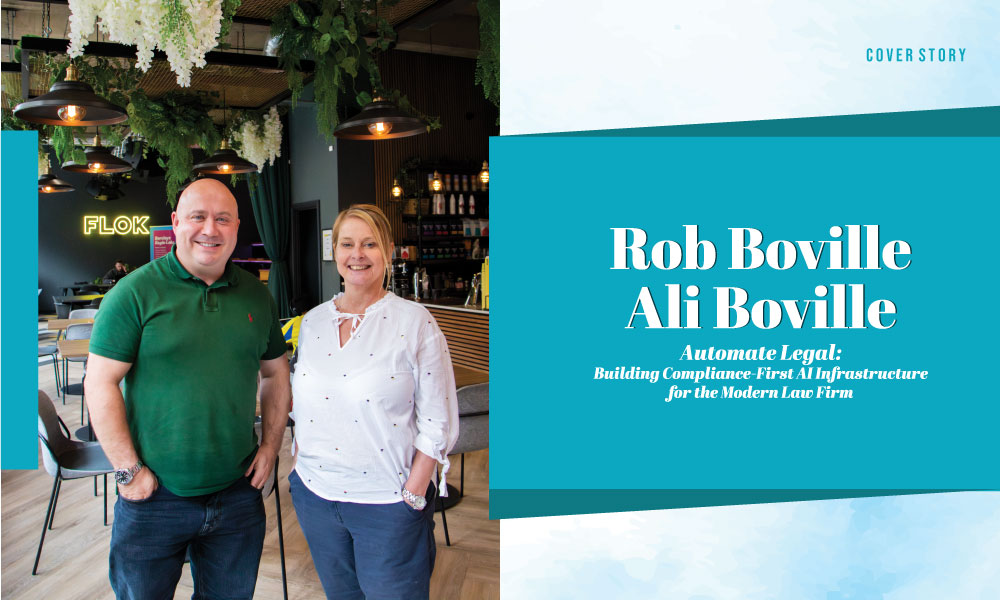
Founded by Rob Boville and Ali Boville, Automate Legal did not emerge from theory. It was built from direct exposure to how legal cost drafting functions in practice. Through their broader work in AI and automation within regulated industries, the founders began engaging with litigation teams and cost professionals. What they discovered was striking.
“Enormous expertise was being applied to a largely manual workflow,” they explain. Bills of costs, Precedent formats, categorisation, and compliance validation were being managed through tools never designed for that level of rule complexity.
But inefficiency was only part of the story. The deeper issue was commercial impact. Cost drafting directly determines recoverability, profitability, and cash flow. Small errors can translate into significant financial losses. Yet professionals were spending hours checking, rechecking, formatting, and validating under time pressure.
“The early vision,” the founders share, “was to build a system that respected the professional judgement of cost drafters while removing the repetitive mechanical work that adds little strategic value.”
Rather than bolting AI onto legacy systems, Automate Legal was formed to build a compliant infrastructure that properly combines structured rule engines with artificial intelligence, enhancing accuracy and speed without compromising regulatory integrity.
Why Cost Drafting Became the Focus
In a LegalTech market saturated with document management and case management tools, Automate Legal chose a narrower but more technically demanding path.
The decision to focus on cost drafting was driven by three factors: complexity, financial sensitivity, and lack of modern tooling.
Cost drafting operates within rigid court-prescribed formats and guideline frameworks. That structure, paradoxically, makes it ideal for intelligent automation if built correctly. At the same time, it is financially critical. The quality of drafting determines what firms recover from cases.
“It wasn’t about chasing a trendy AI application,” the founders clarify. “It was about identifying a workflow where precision and automation could coexist and deliver immediate measurable value.”
Few LegalTech solutions go deep into the intelligence layer of billing compliance. Automate Legal recognized that if a system could understand formatting requirements and rule sets at a granular level, it could unlock meaningful gains for firms, not marginal improvements, but structural ones.
Jurana: AI Built for Regulation, Not Around It
Automate Legal’s flagship platform, Jurana, was architected with compliance as a foundation, not an afterthought.
From the outset, the founders understood that law firms would never adopt AI unless it met strict standards for confidentiality, accountability, and traceability. The legal sector operates under GDPR, SRA obligations, and stringent client confidentiality requirements. Many firms remain cautious about public AI systems due to concerns about data handling and exposure to model training.
“Regulatory expectations did not restrict innovation,” they emphasise. “They shaped it.”
Jurana was therefore built with UK-based secure cloud hosting, clear data segregation, robust access controls, and detailed audit trails. Rather than acting as a generic AI wrapper, the platform embeds artificial intelligence within a controlled architecture that enables outputs to be validated, traced, and reviewed.
Every design decision passes what the founders describe as “the test of professional accountability.”
Solving the Domain-Specific AI Challenge
Training AI for legal cost drafting differs fundamentally from generating marketing copy or drafting general documents. The system must operate within predefined court rules, apply correct categorisation, and reflect billing regimes such as Legal Aid, Court of Protection, and Inter Partes.
The risk in this domain is not underperformance; it is deviation.
“The biggest challenge was preventing creative deviation,” they explain. “In cost drafting, variation is risk.”
To address this, Jurana combines structured data models with rule-based validation engines and AI components that operate strictly within guardrails. The AI does not act independently. Instead, it generates structured content that is validated against compliance logic before final output.
This layered architecture enables intelligent automation without sacrificing predictability or financial accuracy. The result is AI that enhances professional judgement rather than replacing it.
Early Market Validation and Strategic Timing
Before its official launch, Automate Legal attracted significant interest from major law firms. This early validation signals more than curiosity; it reflects readiness.
“It demonstrates that firms are not sceptical of AI in principle,” the founders note. “They are sceptical of poorly designed systems.”
When presented with a platform that demonstrably improves recoverability, reduces drafting time, and aligns with compliance expectations, adoption accelerates.
Law firms today operate under tightening margins, fixed-fee pressures, and increasing client scrutiny around efficiency. Manual process dependency constrains scalability. By automating structured validation and formatting, Jurana enables firms to scale caseloads without increasing headcount in proportion.
Efficiency gains, however, do not translate into workforce reduction. Instead, they reshape how expertise is deployed.
“When drafting and validation time decreases, cost professionals can focus on strategy, negotiation, and optimisation of recovery,” the founders explain. Hybrid roles, combining technical knowledge with AI-assisted oversight, are likely to emerge as automation becomes part of the operating model rather than an add-on tool.
Balancing Productivity with Professional Accountability
Automation in legal workflows cannot be measured solely by speed. Compliance, audit readiness, and traceability remain paramount.
Jurana incorporates structured validation checks, user review controls, and comprehensive audit trails. Outputs can be examined, amended, and verified. Professional accountability remains central.
“Automation should reduce risk, not introduce it,” they assert. “That is why compliance logic and validation layers are integral to the platform rather than optional features.”
This philosophy positions Automate Legal as a standard-setter in responsible AI deployment within regulated professions.
Data Sovereignty and the Future of LegalTech
As AI adoption grows globally, data sovereignty and jurisdiction-specific hosting are becoming decisive procurement factors.
“Firms want clarity on where their data resides, who can access it, and how it is processed,” the founders explain.
In common law jurisdictions, confidentiality obligations are stringent. LegalTech providers that can demonstrate controlled AI usage, transparent governance, and architectural compliance will define the next wave of adoption.
Automate Legal has built its platform with these realities in mind, ensuring alignment not only with current regulations but also with emerging expectations for AI governance.
Driving Trust in a Traditionally Conservative Sector
Law firms often struggle with technology adoption due to legacy workflows and entrenched habits. Automate Legal’s strategy has been collaborative rather than disruptive.
Trust is built through structured pilot programs, direct collaboration with cost professionals, and iterative feedback loops. Instead of promoting abstract AI capabilities, the company demonstrates tangible time savings and measurable financial impact.
“Clear pricing aligned to value delivered also reinforces trust,” they add. Predictability and transparency remain essential in legal procurement decisions.
Looking Ahead to 2026 and Beyond
As Automate Legal looks toward 2026, its ambition extends beyond task automation.
“We see Automate Legal becoming a foundational AI solution provider for regulated legal workflows,” the founders state.
The broader opportunity lies in setting a benchmark for responsible AI deployment within the legal profession, showing that automation can simultaneously increase profitability, strengthen compliance, and enhance professional expertise.
If successful, Automate Legal will not merely streamline cost drafting. It will help define how AI integrates into common law jurisdictions: carefully, responsibly, and with professional standards intact.
In a LegalTech environment where innovation often races ahead of regulation, Automate Legal represents disciplined advancement. Precision over hype. Architecture over shortcuts. Compliance over convenience.
That commitment firmly positions Automate Legal among the 5 Best LegalTech Companies to Watch in 2026 and as a company shaping not only legal workflows but also the future operating model of the modern law firm.
About Automate Legal
Automate Legal is a UK-based LegalTech company developing compliance-first AI solutions for regulated legal workflows. Its flagship platform, Jurana, automates legal cost drafting, billing validation, and formatting with precision and audit-ready security.
The company helps law firms improve recoverability, efficiency, and profitability while maintaining strict data protection and professional accountability standards.
Company Details
- Company Name: Automate Legal
- Founding Year: 2024
- Office Locations: Remote UK-Based
- Official Website: https://automate.legal
- Industry/ Sector: LegalTech
Featured Leader’s Profile
- Names of the Featured Leaders: Rob Boville, Ali Boville
- Designation: Co-Founders
- Brief Background & Experience:
Rob and Ali Boville are serial technology founders and co-founders of both BearTech and Automate Legal. Through BearTech, they have delivered AI-driven software solutions across regulated sectors, including legal, finance, enterprise automation, and cloud infrastructure.
Rob’s expertise lies in crafting intelligent technology systems that solve real operational problems. His background is grounded in building AI architectures and enterprise-grade platforms where compliance, traceability, and performance are non-negotiable.
Ali brings a complementary strength in People and Leadership development. She leads on business strategy, governance, and organisational growth across both companies. Her focus ensures that innovation is matched with structure, culture, and long-term sustainability.
Together, they combine technical execution with strategic discipline.
Company Highlights
- Key Services/Offerings:
- Jurana – AI-powered legal automation platform
- CostDraft – Compliance-first AI cost drafting module
- Major Achievements or Recognitions:
- Global Recognition Award
- Diamond Award – Legal Tech Platform of the Year