


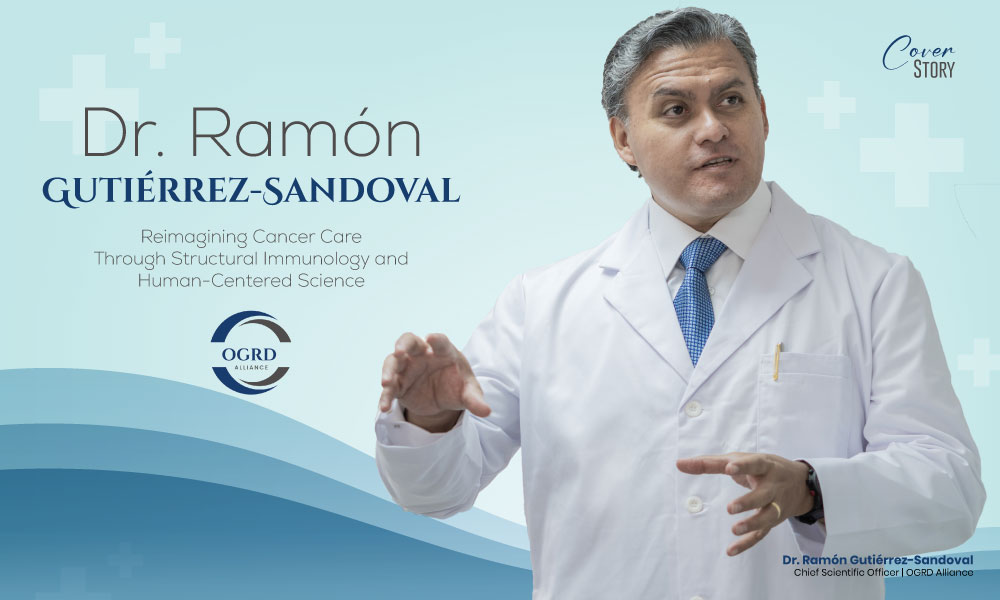
In a global healthcare landscape dominated by increasingly aggressive cancer therapies, escalating costs, and complex infrastructures, OGRD Alliance is asking a question many have avoided: Can cancer be treated effectively while better protecting the people medicine aims to save?
At the center of this inquiry stands Dr. Ramón Gutiérrez-Sandoval, Chief Scientific Officer of OGRD Alliance, a scientist whose work challenges long-standing assumptions about toxicity, immunotherapy, and what true innovation in oncology should look like.
Rather than pursuing increasingly aggressive or invasive solutions, Dr. Gutiérrez-Sandoval is leading a gradual but meaningful shift toward structural immunology, an approach rooted in precision, tolerability, and global responsibility.
A Founding Vision Rooted in Humanity
OGRD Alliance was founded on a simple but urgent realization: in modern oncology, toxicity had gradually become an accepted part of standard treatment.
For Dr. Gutiérrez-Sandoval, years of work in oncology revealed a troubling truth: patients were often enduring treatments as damaging as the diseases themselves.
“Cancer therapy had reached a point where harm was normalized,” he explains. “That prompted the need for a new framework.”
From the outset, OGRD Alliance set out to build a platform where deep science and genuine humanity could coexist. The goal was not incremental improvement but structural change, developing therapeutic solutions designed to better respect the patient, preserve immune integrity, and remain accessible beyond elite healthcare systems.
What began as a focused scientific initiative soon revealed a universal relevance. Across Japan, Singapore, Europe, the Middle East, and Latin America, the same challenges emerged: health systems seeking effective therapies that did not overwhelm patients or infrastructure.
That realization transformed OGRD Alliance from a single laboratory into a coordinated global ecosystem, capable of operating with consistency across multiple regions while maintaining scientific coherence.
The Science Behind PLPC: Precision Without Punishment
At the heart of OGRD Alliance’s work is PLPC, a novel structural immunology platform that departs radically from traditional cancer therapies.
PLPC is neither genetic, nor cellular, and is designed to be non-invasive. It does not modify cells, alter DNA, or induce systemic toxicity. Instead, it is built entirely on endogenous immunological mechanisms, signals the body already recognizes and understands.
“PLPC functions as an immunological architecture,” Dr. Gutiérrez-Sandoval explains. “It reshapes the tumor environment without placing excessive burden on the patient or compromising recovery.”
One of the aspects that differentiates PLPC from many advanced therapies is not only its science but its philosophy of restraint. It is designed to be powerful without being punitive, precise without being destructive.
Globally, the platform has been designed around three core principles that guide its behavior across different healthcare systems:
- An emphasis on structural safety, minimizing risk while preserving immune function
- Verifiable reproducibility is intended to support consistent outcomes across regions
- Global scalability designed to enable broader adoption without extreme infrastructure
Together, these elements position PLPC not merely as a scientific breakthrough, but as a realistic and humane alternative for physicians, regulators, and health systems worldwide.
Building Trust Through Transparency and Structure
Introducing a new therapeutic category requires not only innovation, but also trust. For OGRD Alliance, trust is not a marketing outcome but a daily discipline.
To support PLPC, the organization developed STIP, a structural validation framework that provides traceability, comparability, and objective evaluation across borders.
“STIP is designed to allow regulators, scientists, and institutions to assess the work independently,” says Dr. Gutiérrez-Sandoval. “It aims to reduce subjectivity by introducing a structured evaluation framework.”
Rather than resisting skepticism, OGRD Alliance invites it. External audits, indexed publications, real-time documentation, and open regulatory dialogue are integral to its operating model.
“Transparency is not treated as a strategy, but as a core operating principle.”
By aligning frontier science with disciplined documentation, OGRD demonstrates that innovation and rigor are not opposing forces, but necessary partners.
Global Expansion Driven by Need, Not Hype
In 2025, OGRD Alliance expanded operations beyond the Emirates, entering regions across Asia, Europe, and beyond. This expansion was not driven by aggressive commercialization alone, but by necessity.
The primary challenge was conceptual: PLPC-DB does not behave in the same way as a traditional drug. It does not follow pharmacodynamic pathways, requiring regulators to evaluate it through a different lens.
While this initially generated skepticism, it also opened doors. Japan contributed technical rigor, Singapore provided openness to NAM-based regulatory frameworks, Europe and Asia demonstrated strong interest in non-toxic therapeutic models, and the MENA region aligned with the vision of becoming a biomedical innovation hub. As health systems sought alternatives that protect patients while remaining operationally viable, PLPC-DB was designed to offer a potential path forward grounded in safety, reproducibility, and scalability.
Values That Anchor a Global Mission
OGRD Alliance operates at the intersection of research, regulation, and global deployment, an environment that demands strong ethical grounding.
Three core values guide decision-making across the organization:
- Humanity: recognizing that every scientific choice affects a patient, a family, and a physician
- Honest evidence: ensuring every result is reproducible, auditable, and transparent
- Global responsibility: designing solutions that work across diverse healthcare systems
These values shape a culture where rigorous science is inseparable from empathy, integrity, and equity.
Sustaining Innovation Without Losing Rigor
In a fast-moving biotech landscape, innovation can sometimes outpace structure. OGRD Alliance has taken the opposite approach.
STIP serves as a shared architectural backbone, ensuring that innovation expands within defined parameters rather than fragmenting across teams or regions.
“This helps limit variation and preserve coherence,” Dr. Gutiérrez-Sandoval explains. “Innovation, in this context, is not about breaking rules; it’s about building better ones.”
By anchoring every advancement to measurable standards, OGRD ensures consistency regardless of geography, laboratory, or operational environment.
Responding to Scrutiny With Evidence
Biotechnology is inherently scrutinized, and OGRD Alliance embraces this reality.
Rather than defending claims, the organization demonstrates results: repeatedly, consistently, and transparently.
Independent audits, regulatory engagement, and published data form the foundation of its credibility.
“Credibility comes from demonstration rather than promises,” says Dr. Gutiérrez-Sandoval.
In a competitive global environment, OGRD’s strategy remains clear: respond to doubt with data, uncertainty with clarity, and skepticism with structure.
A Global Problem, A Humane Solution
One of the key challenges OGRD Alliance seeks to address is not purely scientific; it is systemic.
Many countries cannot sustain high-toxicity, high-cost cancer therapies. Patients are often excluded not by biology, but by economics and infrastructure.
Structural immunology offers not merely a theoretical framework, but a potentially valid and synergistic option.
“Our goal is to avoid dividing patients into those who can access treatment and those who cannot,” he says. “It is to expand possibilities.”
The impact OGRD envisions is restoring dignity to cancer care, reducing unnecessary suffering, and empowering health systems to act where traditional models fall short.
Looking Ahead: Priorities for 2026 and Beyond
As OGRD Alliance moves forward, three strategic priorities define its roadmap:
- Regulatory consolidation across Asia, MENA, Europe, and the Americas
- Expansion of licensing and manufacturing models to accelerate regional access
- Advancement of new scientific lines within structural immunology
Above all, the mission remains constant: proving that immunology can be powerful without toxicity.
A Final Message to Global Stakeholders
OGRD Alliance is, at its core, a human project.
“Our work does not end with laboratory results or regulatory filings,” Dr. Gutiérrez-Sandoval reflects. “It ends when a patient, anywhere in the world, receives a treatment that helps without harming.”
To investors, partners, and global stakeholders, OGRD offers not just innovation but responsibility, the science guided by clarity, evidence, and compassion.
That is the path OGRD Alliance continues to walk, and the future it is helping to build.
About OGRD Alliance
OGRD Alliance is a global biomedical organization advancing non-toxic cancer therapies through structural immunology. It develops innovative, non-invasive platforms like PLPC that work with the body’s natural immune mechanisms, prioritizing patient safety, scientific rigor, and global accessibility across diverse healthcare systems.
Company Details
- Company Name: OGRD Alliance
- Founding Year: 2021
- Office Locations: Dubai (UAE), Orlando (USA)
- Official Website: https://plpcplatform.org
- Industry / Sector: Cancer Immunotherapy, Advanced Biotherapeutics, Immuno-Nutraceuticals, Regulatory PharmaScience
Leader’s Profile
- Name of the Featured Leader: Dr. Ramón Gutiérrez-Sandoval
- Designation: Chief Scientific Officer (CSO), OGRD Alliance
- Brief Background & Experience:
Dr. Gutiérrez is an onco-pathologist and scientific architect of the PLPC Platform™, a next-generation ecosystem that integrates structural immunotherapy (PLPC-DB), immunoceutical architecture (PLPC-NX), and the NAM-aligned regulatory backbone STIP. With more than 3 decades of experience in clinical oncology, molecular immunology, and regulatory strategy, his work focuses on developing non-cellular, non-genetic, and non-toxic immunotherapies designed to be globally scalable and ethically deployable. He has led international publications in Q1 journals, multiple presentations in Tier-1 oncology congresses such as ASCO, ESMO, SITC, and CAP25, and the consolidation of a 3,500-patient RWE dataset that supports the platform.
Featured as a Cover Leader in the special edition “Men Leaders to Look Up to 2025,” Passion Vista Magazine — recognizing his international leadership in structural immunotherapy and the development of the PLPC Platform (2025).
Recipient of the Visionaries Award at the Health 2.0 Conference in Dubai — honoring his pioneering contributions to cancer immunotherapy, regulatory science, and the global deployment of the PLPC-DB platform (2025).
Company Highlights
- Key Services / Offerings:
– PLPC-DB™: Structural, non-pharmacodynamic cancer immunotherapy platform
– PLPC-NX™: GRAS-grade immunoceutical architecture (T-Defense, Regenera, Sport, Vitalis)
– STIP™: Structural Traceability & Immunophenotypic Platform (NAM regulatory framework)
– Global licensing, regulatory pathways, manufacturing models, and institutional deployment - Major Achievements or Recognitions:
– 5 peer-reviewed Q1 scientific publications (Cancers, Biomedicines, IJMS, Biology)
– 11 Tier-1 oncology presentations (ASCO, ESMO, SITC, CAP25)
– Two independent pre-FDA audits (Veristat, Freyr Solutions)
– International expansion across MENA, Asia, Europe, and the Americas
– Recognition in multiple leadership and innovation features (Passion Vista, CIO Look, Insights Success, Business Leaders Review)