


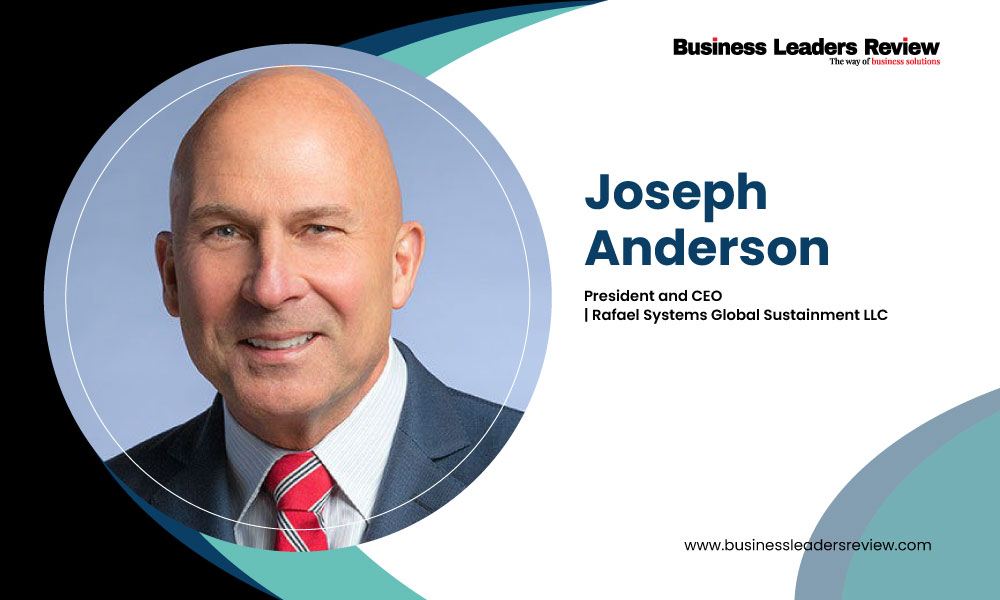
Under President and CEO Joseph Anderson, Rafael Systems Global Sustainment is expanding its people, infrastructure, engineering capabilities, and production-transfer capacity as it works to bring proven defense technologies closer to the U.S. market.
Growth can be measured in revenue, headcount, locations, contracts, or market reach. For Rafael Systems Global Sustainment LLC (RSGS), the numbers tell an important part of the story.
Founded in 2019, the company has grown from seven employees to 27 people working across multiple locations, including overseas operations in Korea and Germany. Revenue has increased from $3.5 million at the company’s early stage to $10.5 million in 2026.
But the more interesting part of that growth is what has been built around those numbers.
RSGS was established as a U.S.-based, FOCI-mitigated proxy company, subsidiary, and authorized broker for Rafael Advanced Defense Systems in Israel. It holds a U.S. Department of Defense Facility Clearance at the Secret level and is staffed entirely by cleared U.S. personnel. Its stated vision is to provide products and services that close capability gaps across U.S. defense, interagency, federal, and state markets.
Its mission is equally focused on execution: bringing tested and proven technical solutions to the North American market while providing the integration and sustainment support required to keep those capabilities useful over time.
That combination of technology, localization, engineering, and long-term support is shaping the company’s next phase.
Growth With a Purpose
For President and CEO Joseph Anderson, expansion is not simply about adding another office or pursuing a larger contract.
RSGS is building the infrastructure needed to support a broader U.S. presence.
One of the company’s central priorities is what it describes as the “Americanization” of Rafael technologies.
That process involves much more than bringing an existing product into the country.
It requires people with U.S.-based technical, programmatic, and business expertise. It requires processes capable of handling sensitive technology, intellectual property, software, and data. And it requires infrastructure that can support U.S.-based manufacturing and production transfer.
RSGS approaches that work through three connected areas: People, Processes, and Infrastructure.
The people side includes expertise across combat systems, systems engineering, software, modeling and simulation, testing, life-cycle support, field service, and demonstrations.
The process side includes a secure “one-way gate” for transferring, storing, and protecting products, IP, software, and data, along with contracting pathways, classified storage, cybersecurity assessments, and management of data rights and intellectual property.
The infrastructure side is focused on developing U.S.-based manufacturing capability through partnerships with sister subsidiaries, American companies, and public-private initiatives.
It is a demanding model, but it is also central to the company’s growth strategy.
Turning Expansion Into Capability
A growing company needs more than demand. It needs systems that can handle that demand.
RSGS reached an important milestone in compliance with ISO 9001:2015 and AS9100D.
For the company, these certifications are not simply credentials to display. They have helped standardize processes, strengthen traceability, and reduce risk across engineering, production, and sustainment activities.
They also provide an additional layer of confidence for U.S. government customers, prime contractors, and OEM partners working with sensitive technologies and mission-critical systems.
Perhaps more importantly for a fast-growing organization, the quality framework gives RSGS a foundation from which it can pursue larger programs.
As the company expands its manufacturing and production-transfer capabilities, maintaining consistency becomes increasingly important.
Growth creates opportunities. It also creates more places where things can go wrong. RSGS is building its processes with that reality in mind.
A New Footprint in Michigan
Geographic expansion is another visible sign of the company’s development.
RSGS opened an office in Michigan to strengthen its proximity to key Army, ground-combat, and defense-industrial customers.
The location also brings the company closer to an established engineering and advanced-manufacturing ecosystem, as well as a strong talent base.
For RSGS, the Michigan presence is intended to support more than customer access. It is part of a broader effort to expand engineering, sustainment, and production-transfer capacity in the United States.
The company sees the location as a way to improve responsiveness, strengthen customer engagement, and accelerate integration timelines.
The next objective is to build a similar capability in Huntsville, Alabama.
Together, these locations form part of a larger strategy: creating a U.S. footprint capable of supporting the company’s Americanization model as it scales.
Four Capabilities, One Portfolio
RSGS’s business is organized around four capability areas: Spike Missiles, Counter-UAS/Air & Missile Defense, Medium Caliber Weapon Station, and Trophy Active Protection System.
The company views these not as isolated businesses, but as an integrated portfolio.
Each addresses a different area of mission need, while engineering, production-transfer, sustainment, and field-service teams work across the portfolio.
That integration allows technical knowledge and support capabilities to be shared rather than developed independently within separate silos.
For customers, the objective is a coordinated approach across lethality, protection, and survivability.
For RSGS, it creates a broader platform from which the company can continue expanding its U.S. capabilities.
From Contracts to Long-Term Relationships
The past year has brought several developments across the company’s portfolio.
RSGS has supported U.S. Government programs through expanded Spike missile activities, continued integration and field support for Trophy APS, and increased participation in Counter-UAS and Air & Missile Defense demonstrations, including the JIATF 401 Shoot-Off and upcoming laser integration events.
The company has also submitted four Commercial Solution Offerings under SHIELD, progressed APFIT-funded efforts for FY27, and advanced Cooperative Research and Development Activities intended to strengthen U.S. variants of Rafael systems.
Partnerships have expanded as well, including work involving Naval Special Warfare on mini-Typhoon and broader production-transfer collaborations.
The significance of these activities is not simply the number of programs involved.
Together, they reflect a company moving from representation and support toward a broader role in engineering, integration, production transfer, and sustainment.
That is an important distinction for a company entering its next stage of growth.
Growth Does Not End at Delivery
In defense and aerospace, delivering a system is only one part of the relationship.
The years that follow can determine whether that system continues to provide value.
RSGS has built its sustainment model around this reality.
Its lifecycle support framework includes depot-level maintenance, field-service teams, spare-parts provisioning, configuration management, and structured upgrade paths.
Engineering, production-transfer, and sustainment teams work together to maintain system health, address obsolescence, and support continuing improvements.
The approach is designed to keep capabilities mission-ready while reducing downtime and giving customers greater predictability over the life of a system.
This is also where the company’s name becomes particularly relevant.
Global Sustainment is not simply an extension of the product business. It is part of the value proposition.
For RSGS, long-term support is connected to reliability, customer confidence, and the ability to build lasting relationships.
Staying Responsive in a Changing Market
Defense technology does not operate in a static environment.
Threats evolve.
Regulations change.
Supply chains experience pressure.
Technology moves quickly.
RSGS’s response has been to bring engineering, production transfer, sustainment, and field service closer together so the company can move from requirement to prototype, integration, and support with fewer gaps between functions.
Customer proximity is another part of the approach.
The company works through demonstrations, CRADAs, and early-stage requirement shaping to maintain contact with real-world operational needs.
At the same time, secure infrastructure, classified capabilities, cybersecurity processes, and an expanding U.S. footprint are intended to allow RSGS to move quickly without losing the discipline required in sensitive programs.
Speed, in this context, is not about cutting corners.
It is about having the right pieces in place before the need becomes urgent.
The Leadership Behind the Scale
Rapid growth can put pressure on an organization’s culture.
More employees mean more communication.
More locations mean more coordination.
More programs mean more opportunities for complexity.
RSGS’s leadership approach centers on disciplined execution, transparency, accountability, and mission alignment.
The company emphasizes clear communication, rapid decision-making, and cross-functional collaboration across engineering, production transfer, sustainment, and field service, which keeps programs synchronized as we grow.
At the same time, strict compliance, configuration control, security practices that reinforce trust with DCSA, OEM partners, and government customers remain central to how programs are managed.
This combination of disciplined leadership, empowered teams, and unwavering commitment to quality enables RSGS to expand its footprint while preserving the reliability and confidence our stakeholders expect.
That balance is particularly important for an organization growing within highly regulated and technically demanding markets.
RSGS’s approach is to give teams room to act while maintaining the controls needed to protect quality, security, and customer trust.
The Next Stage Is Already Taking Shape
RSGS enters the next phase of its growth with an ambitious agenda.
The company plans to expand U.S.-based engineering and manufacturing capacity, accelerate the Americanization of Rafael systems, strengthen production-transfer partnerships, and invest in secure infrastructure supporting classified development, rapid prototyping, and lifecycle sustainment.
Its future technology priorities include precision strike, Counter-UAS/Air & Missile Defense, armored-vehicle survivability, laser-based C-UAS, advanced sensors, and next-generation lethality.
The company also plans to expand its Michigan footprint, increase CRADA-driven innovation, strengthen supply-chain resilience, and pursue additional capability areas aligned with emerging U.S. Government requirements.
These priorities point to a company that is no longer simply focused on growing its presence.
It is building the capacity to do more.
Growth Measured in Capability
RSGS’s growth story is ultimately larger than the jump from $3.5 million to $10.5 million in revenue in 2026.
It is the story of a company that began with seven people and has expanded to 27 across multiple locations.
It is the story of a U.S. organization building engineering, manufacturing, production-transfer, and sustainment capabilities around advanced defense technologies.
It is also a story about localization.
The company’s objective is not merely to bring technologies into the U.S. market, but to develop the people, processes, infrastructure, partnerships, and quality systems needed to support them here.
That makes the next phase particularly significant.
RSGS is building toward a model in which American engineering and manufacturing capability sits alongside technology expertise, secure infrastructure, field support, and long-term sustainment.
For a company featured among the 10 Fastest Growing Companies of the Year 2026, that is the part of the story worth watching.
Because growth is not only about becoming bigger.
For Rafael Systems Global Sustainment, it is about becoming capable of doing more at greater scale, across more locations, with deeper U.S. capabilities and a longer-term role in the defense ecosystem.
And under Joseph Anderson’s leadership, that next stage is already being built.
About Rafael Systems Global Sustainment LLC
Rafael Systems Global Sustainment LLC (RSGS) is a U.S.-based defense technology and sustainment company that supports the integration, engineering, manufacturing, and sustainment of Rafael defense technologies for U.S. customers.
Company Details
- Company Name: Rafael Systems Global Sustainment LLC
- Founding Year: 2019
- Office Locations: 1902 Campus Commons Drive Reston, VA 20191
- Office Website: rsgsllc.com
- Industry/ Sector: Defense Contractor
Featured Leader’s Profile
- Name of the Featured Leader: Joseph Anderson
- Designation: President and CEO
- Brief Background & Experience:
Lieutenant General (Ret.) Joseph “Joe” Anderson currently serves as the President and Chief Executive Officer of Rafael Systems Global Sustainment (RSGS), the American subsidiary of the Israeli defense firm Rafael Advanced Defense Systems. Prior to his role at RSGS, Anderson enjoyed a distinguished career in the United States Army, retiring as a Lieutenant General. His leadership style and strategic focus at RSGS are frequently credited to the experience he gained during his military service.
As President and CEO, Anderson is responsible for setting the company’s strategic vision, driving its growth, and overseeing daily operations as the firm supports defense sustainment requirements. His leadership at RSGS has garnered industry recognition, including being named a 2025 Wash100 Award recipient for his contributions to promoting technological innovation within the defense sector.
Company Highlights
- Key Services/Offerings: RSGS organizes its efforts around three primary lines of activity:
- Engineering Services: RSGS provides specialized engineering expertise to adapt, integrate, and support advanced systems for U.S. defense applications.
- Manufacturing & Fabrication: The company offers manufacturing capabilities, including component fabrication and welding, to support the production and maintenance of defense technologies domestically.
- IP/Data Storage & Sustainment: RSGS manages the intellectual property and technical data necessary to support the lifecycle of the systems they provide. This includes deep involvement in system sustainment, ensuring that deployed technologies remain operational and integrated within U.S. military architectures.
- Major Achievements or Recognitions:
- 2021 Platinum Hire Vets Medallion Award
- 2023 Gold Hire Vets Medallion Award
- 2023 Employer Support of the Guard and Reserve Patriotic Employer
- 2024 Business Honor, Best in the Business Awards
- 2025 Gold Hire Vets Medallion Award
- 2025 Virginial Values Veteran, V3 Certified Company
- 2026 Virginia Best Places to work #19 Small Employer Category
- 2026 Virginia Best Places to Work Career Growth #4
- 2026 The Silicon Review, 30 Innovative Brand of the Year
- 2026 U.S. Forces in Business Awards, Finalist: Employer of the Year Category