


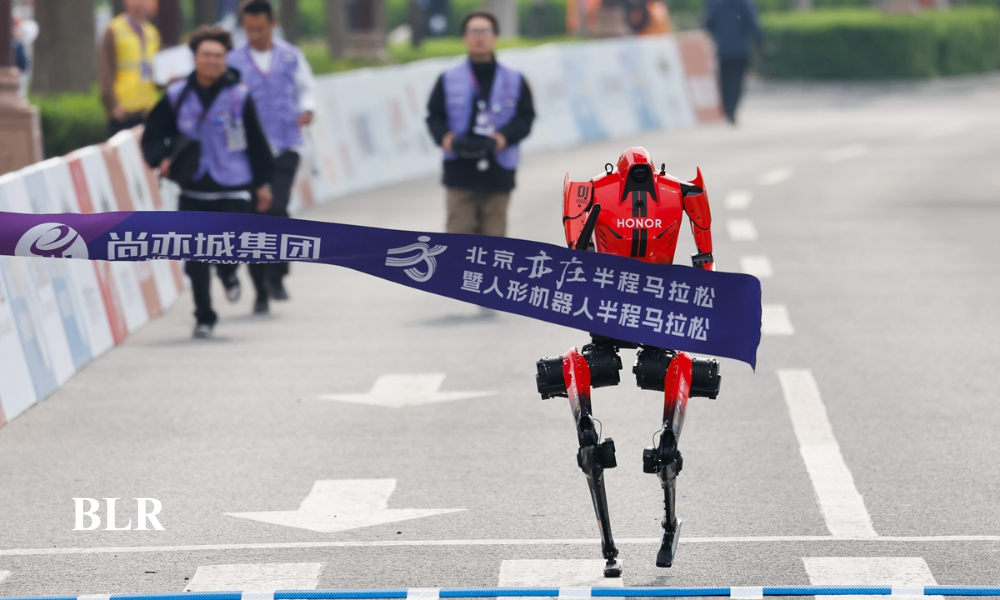
Key Highlights
- Lightning clocked 9.32 seconds in the 100m test, faster than Bolt’s 9.58-second human record.
- The robot previously completed a 21km half-marathon in 50 minutes and 26 seconds.
- More than 2,000 humanoid robots are taking part in Beijing’s five-day Robot Games across 51 events.
A Chinese humanoid robot has reportedly completed the 100-metre sprint in 9.32 seconds, surpassing Usain Bolt’s iconic 9.58-second human world record. Honor, the Chinese smartphone company, has built a robot called Lightning that hit a top speed of 14.5 metres per second. It was built during a preparatory test for the second World Humanoid Robot Games in Beijing.
A Record-Breaking Sprint
Lightning’s reported time is 0.26 seconds faster than Bolt’s record, set at the 2009 World Athletics Championships in Berlin. However, the performance is a robot test result rather than an official human athletics record; Bolt’s 9.58 seconds remains the recognised men’s 100m world record.
The sprint is another milestone for Lightning. In April, the humanoid won the Beijing half-marathon in 50 minutes and 26 seconds, a pace faster than the human men’s world-record pace. Engineers later extended its legs from 95cm to 1.05 metres ahead of the robot games.
China’s Growing Robotics Ambition
The achievement comes as China accelerates its push into humanoid robotics, with policymakers and companies viewing advances in artificial intelligence and hardware as potential drivers for applications in manufacturing, logistics and consumer technology.
The second World Humanoid Robot Games opened in Beijing on August 22, with more than 2,000 robots participating in 51 events and over 1,000 competitions. Activities include running, football, table tennis, weightlifting and tug of war, with participants from 16 countries, including Germany, Japan and the US.
The event is being held at Beijing’s National Speed Skating Oval, the venue built for the 2022 Winter Olympics.
Robots Challenging More Human Records
Lightning’s sprint was not the only headline-making performance.
Another humanoid robot reportedly achieved a 2.88-metre standing high jump, surpassing the human record of 2.45 metres set by Cuba’s Javier Sotomayor in 1993. The robot was developed by Beijing-based X-Humanoid.
These performances demonstrate how quickly robotic movement is improving, although experts point out that humanoid robots remain largely focused on demonstrations, research and early-stage applications. Mass deployment in everyday environments will require further advances in reliability, autonomy and practical performance.
From Sporting Spectacle to Real-World Technology
The bigger significance of the Robot Games may therefore lie beyond the records themselves.
China is increasingly using robotics competitions as platforms to demonstrate advances in hardware, artificial intelligence, movement and coordination, while companies look for ways to transition these capabilities into practical applications.
For spectators, the progress is already remarkable. Beijing resident Li Yanfeng described humanoid robots as “evolving rapidly,” while another spectator, Yang Shangzheng, said seeing robots perform sports normally associated with humans was “amazing.”
Lightning may not officially replace Usain Bolt in the record books, but its 9.32-second sprint is a striking demonstration of how rapidly humanoid robotics is moving from impressive prototypes toward increasingly capable machines.