


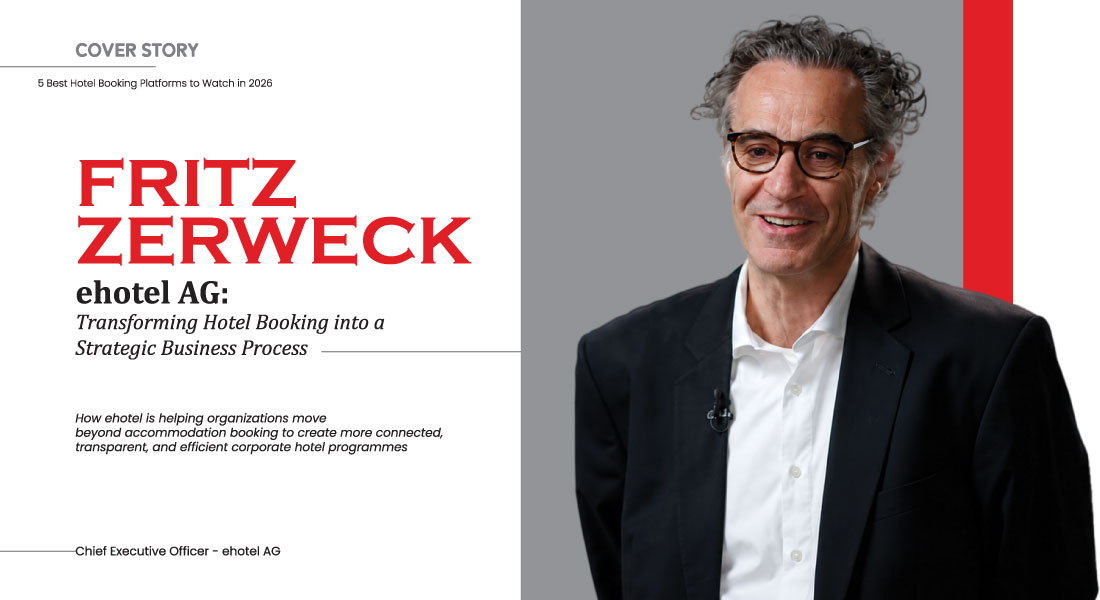
How ehotel is helping organizations move beyond accommodation booking to create more connected, transparent, and efficient corporate hotel programmes
Growth rarely happens without complexity. As organizations expand across markets, adopt new technologies, and connect increasingly diverse business functions, processes that once appeared administrative can quickly become strategically important.
Corporate hotel programmes are a strong example of this transformation.
For years, hotel programmes were largely defined by negotiated rates, preferred hotel agreements, booking compliance, and traveller convenience. These priorities remain important, but the modern corporate environment demands considerably more. Every hotel booking now sits within a wider chain of financial and operational activities involving payment, invoicing, VAT compliance, cost allocation, reporting, sustainability data, and enterprise integration.
What begins as a simple accommodation booking can therefore have implications for finance, procurement, travel management, and organizational reporting.
This changing landscape has shaped the evolution of ehotel AG, which has spent the past 25 years developing a broader perspective on corporate hotel booking that connects accommodation with the business processes surrounding it.
When Booking Becomes Business Operations
The transformation of corporate travel reflects a wider change taking place across modern enterprises.
Organizations are increasingly moving away from isolated workflows and towards integrated processes in which information can move seamlessly between departments and technology platforms. The objective is no longer simply to complete individual tasks faster. Businesses want greater transparency, stronger governance, reliable data, and better visibility into operational performance.
Corporate hotel programmes are becoming part of this shift.
As companies expand internationally, hotel content may come from multiple suppliers, payment methods become increasingly diverse, and regulatory requirements vary across markets. At the same time, finance teams require greater visibility, procurement teams seek consistency, and business leaders expect measurable performance from operational programmes.
Managing all of these requirements through disconnected systems and manual processes can create unnecessary complexity.
The result is a growing demand for hotel booking solutions that function as part of the broader enterprise rather than as standalone travel tools.
Redefining the Role of Corporate Hotel Programmes
This changing environment is also redefining what organizations expect from their corporate hotel programmes.
Travel managers are no longer focused solely on helping employees find accommodation or ensuring that bookings comply with corporate policy. Their responsibilities increasingly intersect with broader organizational objectives, including financial visibility, administrative efficiency, reporting, and operational control.
A successful hotel programme therefore needs to support more than the traveller.
It needs to support the organization behind the traveller.
This means connecting travel activity with the processes that follow every booking from payment and invoicing to VAT-compliant processes, reporting, and data management.
For businesses operating across multiple markets, this connected approach can make the difference between a programme that simply facilitates bookings and one that contributes meaningfully to organizational efficiency.
The Changing Role of Travel Management Companies
The same evolution is influencing the expectations placed on travel management companies.
Corporate clients increasingly require more than access to hotel accommodation. They are looking for strategic partners that can help bring together fragmented hotel content, financial processes, technology systems, and programme management across countries and business units.
This is changing the way value is measured.
Hotel content and booking functionality remain fundamental, but they are no longer the only indicators of a successful corporate hotel programme. Increasingly, organizations are assessing how effectively a platform integrates with their existing enterprise environment, simplifies financial processes, improves reporting, supports compliance, and reduces administrative complexity.
In this environment, technology becomes more than a booking tool.
It becomes a business enabler.
Technology That Connects the Business Process
The evolution of business travel technology reflects this changing expectation.
Earlier generations of innovation focused heavily on improving booking speed, expanding hotel inventories, and creating more convenient user interfaces. These capabilities continue to matter, but businesses are now asking broader questions.
- Can the solution integrate with existing enterprise systems?
- Can it simplify financial processes?
- Can it improve reporting and visibility?
- Can it support compliance?
- Can it reduce manual administration?
And perhaps most importantly, can it scale alongside the organization?
These questions demonstrate a fundamental shift in how corporate travel technology is evaluated. Organizations are increasingly looking beyond isolated travel applications and towards connected capabilities that contribute to wider business processes.
A Connected Approach to Hotel Programme Management
This perspective has been central to ehotel’s development over the past 25 years.
Rather than treating hotel booking as an isolated transaction, ehotel has viewed it as one component of a broader business process. As the requirements of corporate customers have evolved, so too has the company’s focus by extending beyond accommodation content to the operational activities that surround every booking.
Payment, invoicing, VAT-compliant processes, reporting, and enterprise integration have therefore become important elements of the overall approach.
The underlying objective is straightforward: connect the processes surrounding hotel bookings so organizations can operate with greater efficiency, transparency, and financial control.
This connected model can also reduce the administrative burden created by fragmented workflows. When travel, finance, and procurement processes are better connected, organizations can work with more consistent information and gain greater visibility into their hotel programmes.
The value, ultimately, extends beyond the individual booking.
It lies in what the organization can achieve with the information and processes surrounding that booking.
Innovation Through Continuous Improvement
For Fritz Zerweck, CEO of ehotel, this evolution represents a broader philosophy about innovation itself.
“Innovation is not defined by isolated breakthroughs. It is achieved through the continuous improvement of business processes, ensuring they evolve alongside the organizations they support.”
The statement reflects an important distinction in a rapidly changing technology landscape.
Innovation does not necessarily mean replacing an entire system with something radically new. In many business environments, meaningful innovation comes from identifying where complexity exists, connecting previously fragmented processes, and continuously improving the way information and operations move through an organization.
For corporate hotel programmes, this means moving beyond the idea of booking accommodation as an isolated activity.
It means creating a process that can support the wider needs of travel, finance, procurement, compliance, and reporting.
As Zerweck puts it, “Sustainable innovation comes from making complex operations simpler, more connected and more valuable over time.”
Building the Future of Corporate Hotel Booking
The evolution of corporate travel is unlikely to stop at better booking experiences. As enterprises become increasingly interconnected, the systems supporting business travel will need to become equally connected.
Hotel programmes will continue to play an important role in this transformation, not simply as mechanisms for securing accommodation, but as components of broader operational frameworks.
For organizations, the opportunity lies in turning fragmented processes into connected ones, transforming booking data into useful business information, and reducing the administrative complexity surrounding every transaction.
This is the direction in which ehotel has developed its approach over the past quarter century.
By viewing hotel booking through the wider lens of business operations, the company is helping redefine what a corporate hotel programme can deliver.
The future of hotel booking, therefore, may not be about booking more efficiently alone.
It may be about connecting every process that begins with the booking and turning that connection into a strategic business advantage.
About ehotel AG
ehotel AG is a corporate hotel booking and travel technology company with 25 years of experience. It helps organisations simplify hotel programmes by connecting booking, payment, invoicing, compliance, reporting, and enterprise processes.
Company Details
- Company Name: ehotel AG
- Founding Year: 2000
- Office Locations: Erich-Weinert-Straße 145 F 10409 Berlin
- Official Website: https://www.ehotelag.com/
- Industry / Sector: Travel & Hospitality
Featured Leader’s Profile
- Featured Leader: Fritz Zerweck
- Designation: Chief Executive Officer (CEO)