


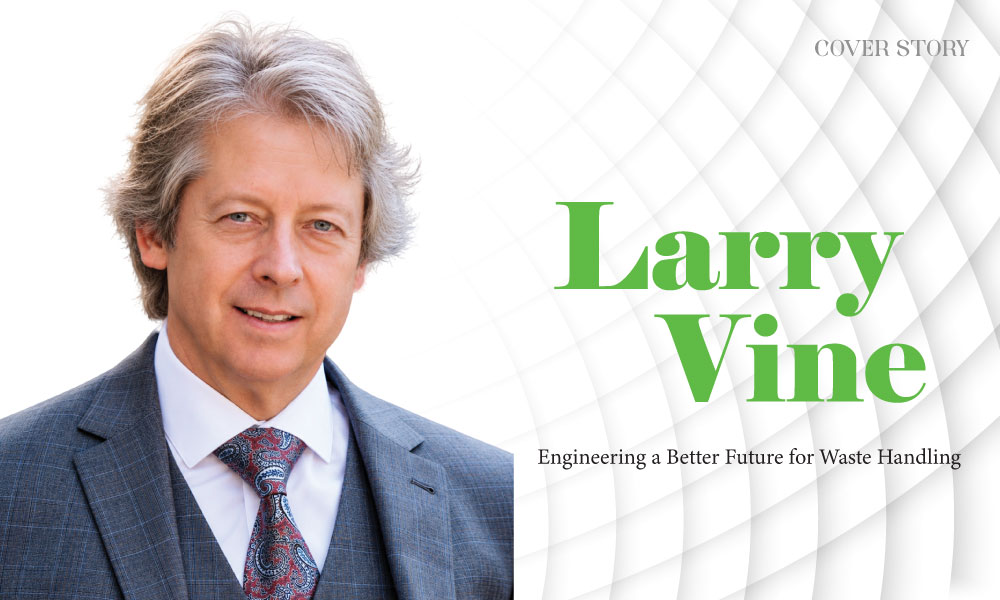
How Larry Vine built Reaction Distributing around a different way of thinking about waste handling
In 1989, Larry Vine was hired by an equipment manufacturer with a straightforward assignment: increase sales and market share.
What he discovered during his time there would eventually lead him in a very different direction.
Vine saw that the company’s business model was missing something fundamental. The equipment itself was only part of the answer. What mattered just as much was how that equipment integrated into the customer’s entire operation.
“It became obvious that their business model was lacking one key ingredient,” Vine recalls. “It failed to recognize and address the total integration of their equipment solution within the client’s operation.”
The company’s reluctance to expand its engineering capabilities and adopt what Vine describes as a “holistic approach” to systems design ultimately led to his departure.
In 1993, he turned that realization into a company of his own.
Reaction Distributing Inc. was founded with a vision of providing the solid waste handling industry with a “better solution.” More than three decades later, that idea continues to shape how the company approaches everything from equipment design and automation to safety, sustainability, and complex healthcare projects.
Seeing the Whole System
Reaction Distributing did not begin with the ambition of becoming another equipment supplier.
Its starting point was a different question: What happens when equipment is designed around the customer’s entire operation rather than treated as an individual product?
That question became the foundation of the company’s business model.
Vine describes the evolution simply: the departure from his former employer “resulted in the creation of Reaction Distributing Inc. and the beginning of my vision of providing totally integrated solid waste handling solutions.”
That emphasis on integration has since become one of the company’s defining characteristics.
Reaction Distributing works across dry waste, wet waste, recycling, compacting, trash chutes and material handling. But the company does not approach these categories as isolated equipment requirements.
Its engineering teams look at the broader operation, identify problems, consider potential efficiencies and determine how automation can reduce labor demands and improve safety.
That philosophy has helped drive the company’s growing recognition across Canada and parts of the United States.
“A focus on engineering and engineered solutions has skyrocketed our recognition within Canada and parts of the United States,” Vine says.
The approach has been particularly visible in the healthcare sector, where Reaction Distributing has attracted the attention of major Canadian players during a period of significant hospital development.
“There is currently a surge within Canada of new hospital projects,” Vine explains, adding that RDI is now recognized as a premier solutions provider for these projects “from coast to coast.”
Engineering the Value
For Reaction Distributing, engineering is not something added after a piece of equipment has been selected.
It is where the solution begins.
“Total equipment solutions have been the driving force behind our growth and our rise to a leadership position,” Vine says.
The distinction is important.
Rather than waiting for customers to identify every problem themselves, the company looks for issues that may not yet be obvious to the client. From there, its solutions focus on three areas that can have an immediate operational impact: automation, safety and minimizing the internal labor burden associated with waste handling.
“We recognize issues that our clients very often are not even aware of,” Vine explains.
That means the value of a project is not measured only by what equipment is installed. It is also measured by what the system allows the client to do better afterward.
A well-designed system can reduce manual work, improve operator safety, streamline material movement and make the overall process more efficient.
The result is a solution designed around the operation rather than an operation forced to adapt around the equipment.
A Design Process That Becomes Instinctive
With experience, the company’s holistic approach has become deeply embedded in its design process.
Vine describes it as “almost self-fulfilling.”
“No matter how large the overall scope,” he says, “our design team’s approach is now 100% instinctive.”
Every project begins with the same fundamental questions.
- What problems need to be solved?
- What efficiencies can Reaction Distributing add?
- Where can automation have the greatest impact on labor?
- How can operator safety be improved?
- And how can client exposure be reduced?
The process is not limited to a single department.
Experience is combined with input from sales, manufacturing, engineering and installation teams. Projects can involve multiple design options being explored simultaneously before the final solution is determined.
“Each project undergoes an internal ‘team’ discussion process,” Vine explains. That collaborative process allows the engineering department “to create the most inclusive designs possible.”
It is a model built around the belief that the strongest solution comes from bringing different forms of expertise into the same conversation.
Technology Expands What Is Possible
Technology has become an important part of that conversation.
Reaction Distributing uses 3-D software that gives engineers and clients the ability to examine designs from multiple perspectives. This can reveal potential equipment or building issues while a project is still on the drawing board rather than after installation has begun.
“This ability means we can identify equipment/building issues at the design stage instead of the installation stage,” Vine says.
For particularly complicated projects, the company uses LiDAR to generate accurate, real-life models that can form the basis of the final equipment solution.
The benefits extend beyond visualization.
According to Vine, the technology can accelerate design, manufacturing and installation while giving the client a model of the completed design to retain.
PLC-based systems have also changed what can be achieved once equipment is in operation.
The technology has had a substantial effect on the form and function of compactors and balers, while automation and monitoring have become considerably easier than they were two decades ago.
For Reaction Distributing, technology is therefore not simply about adding sophisticated features.
It has become an enabler of the company’s holistic design philosophy.
“Advances in technology have been a key ingredient in our ability to create our holistic designs,” Vine says.
Efficiency as a Sustainability Strategy
Reaction Distributing’s approach to sustainability is closely connected to the way it designs its systems.
Rather than treating carbon reduction as a separate objective, the company looks for ways to make the entire waste-handling operation more efficient.
“Providing equipment solutions that are more efficient is the key,” Vine says.
One example is maximizing payloads. When systems can accommodate greater payloads, customers may require fewer annual pickups, which means fewer waste-hauler truck trips to and from the site.
Monitoring systems can further support that objective by helping ensure containers reach maximum fullness before collection.
Other design decisions can have a similar effect.
Reducing the number of electromechanical components can reduce the likelihood of failures, which in turn can mean fewer parts replacements and fewer service-related trips.
More efficient hydraulic power units can reduce equipment running time and electricity consumption.
There is also the question of longevity.
“A better designed system will ensure a longer working life,” Vine says. That can mean fewer equipment replacements over time and, consequently, a lower carbon footprint for the client.
The company’s sustainability philosophy therefore starts with a practical engineering question: how can the system perform better while requiring less from the resources around it?
When the Design Gets Complicated
Some of the clearest examples of Reaction Distributing’s approach have emerged from projects where the requirements are anything but simple.
A recent healthcare-sector project presented one of the company’s most demanding design challenges.
The client had several equipment “must-haves” that needed to be incorporated into one all-inclusive solution.
The system had to maintain building pressure, accommodate AGV-based waste transfer carts, maximize back-of-house security, increase automation and efficiency, and, above everything else, maximize operator safety.
The challenge was not simply meeting each requirement individually.
They had to work together.
“Our team recognized that these design requirements meant the design process had to become more fluid,” Vine says, particularly because the project involved equipment layers the company had not previously had to incorporate in the same way.
For Reaction Distributing, that experience reinforced an important principle: a holistic approach cannot be rigid.
The design process has to evolve as the requirements become more complex.
A Model Built to Handle More
That flexibility may become increasingly important as the waste management industry changes.
Waste volumes, recycling expectations, workplace safety requirements and environmental priorities continue to introduce new demands for facility operators.
For Reaction Distributing, the answer is not to simplify the requirements. It is to build a design model capable of absorbing them.
“This is where our business model shines,” Vine says.
“RDI’s holistic approach has proven itself to be very flexible in so far as its ability to handle an increasing number of client must-haves that can add significant layers to the design process itself.”
The company has been recognized for that flexibility, but Vine says the team continues to be impressed by how far the model can adapt.
“As our clients demand more, our designs continue to deliver more.”
That statement captures much of what has defined Reaction Distributing since its founding.
The company’s competitive advantage is not necessarily tied to doing one thing repeatedly in exactly the same way.
It comes from being able to understand what a particular project demands and then engineer a solution around those demands.
Leadership Through Expertise
That philosophy extends into the company’s culture.
Vine attributes Reaction Distributing’s success first and foremost to its team.
“RDI’s success is due to our team’s dedication first and foremost,” he says.
His own role is centered on setting an example and giving employees the resources and authority required to perform at their best.
“I always lead by example, and I give my staff the mandate and the tools they need to do their jobs.”
Micromanagement, he says, has no place in the organization.
“Micro-manage is not a term that exists at RDI.”
Instead, employees are trusted as experts in their respective fields and given the opportunity to strengthen those skills and develop solutions that are genuinely their own.
That trust is balanced by a strong emphasis on engineering.
“Nothing happens at RDI unless engineering has been involved,” Vine says.
For him, that involvement is essential to achieving strong solutions, sound fabrication principles and effective installations.
The approach also proved valuable during one of the most disruptive periods the industry has experienced in recent years.
“The pandemic taught us very quickly that our continued focus on engineering meant that RDI was able to adjust quickly,” Vine says.
The company came through the period, he adds, “a much stronger company.”
Not the Biggest. The Best.
Looking ahead, Vine is not defining Reaction Distributing’s future simply in terms of size.
“At RDI we strive not to be the biggest but to be the best.”
For him, that means becoming “the best systems solution provider possible.”
It is an ambition that naturally points toward more demanding work.
By continuing along its current path, the company expects to encounter larger and more technically challenging projects, including work at volumes that competitors may not be structured to handle.
The logic is straightforward.
Greater capability creates the opportunity to take on more complex challenges. Successfully solving those challenges strengthens the company’s influence, which in turn supports growth in sales and reputation.
“As our influence in the industry grows so does our sales volume and our reputation,” Vine says.
The Better Solution
Reaction Distributing began with a realization: an equipment solution means little if it does not work within the customer’s larger operation.
That realization became a business model.
More than 30 years later, the company’s work continues to revolve around the same principle, even as the technology, facilities and requirements have changed.
Engineering sits at the center. Collaboration connects the disciplines. Technology makes increasingly complex designs possible. Sustainability is built into efficiency. Safety remains a fundamental consideration.
And the company’s original ambition remains intact.
To find the better solution.
For Larry Vine, that does not necessarily mean building the biggest company in the industry. It means continuing to understand the problems others may overlook, bringing the right expertise together and creating systems capable of delivering more as customers ask more of them.
That is the thinking that started Reaction Distributing in 1993.
It is also the thinking that continues to define where the company is going.
About Reaction Distributing Inc.
Reaction Distributing Inc. (RDI) is a Canadian provider of engineered, turnkey solid waste handling solutions. Founded in 1993, the company designs integrated systems for healthcare, commercial, industrial, and residential environments, with a focus on automation, safety, efficiency, and reducing operational and environmental impact.
Company Details
- Company Name: Reaction Distributing Inc.
- Founding Year: 1992
- Office Locations: Plant: 95 Woodworth Avenue, St. Thomas, Ontario, Canada, N5P 3J9, HQ: 19 Brock Street, Ajax, Ontario, Canada, L1S 1S9
- Official Website: www.reactiondistributing.com
- Industry/ Sector: solid waste handling equipment
Featured Leader’s Profile
- Name of the Featured Leader: Larry Vine
- Designation: President/Director
- Brief Background & Experience: 40 years of sales, design, manufacturing and leadership experience
Company Highlights
- Key Services/Offerings: Design, manufacturing, installation and service of holistic/integrated solid waste handling systems
- Major Achievements or Recognitions: 2026 top waste handling equipment manufacturer in Canada as chosen by Environmental Business Review magazine, featured on the 2026 Globe and Mail list of fastest growing Canadian companies.