


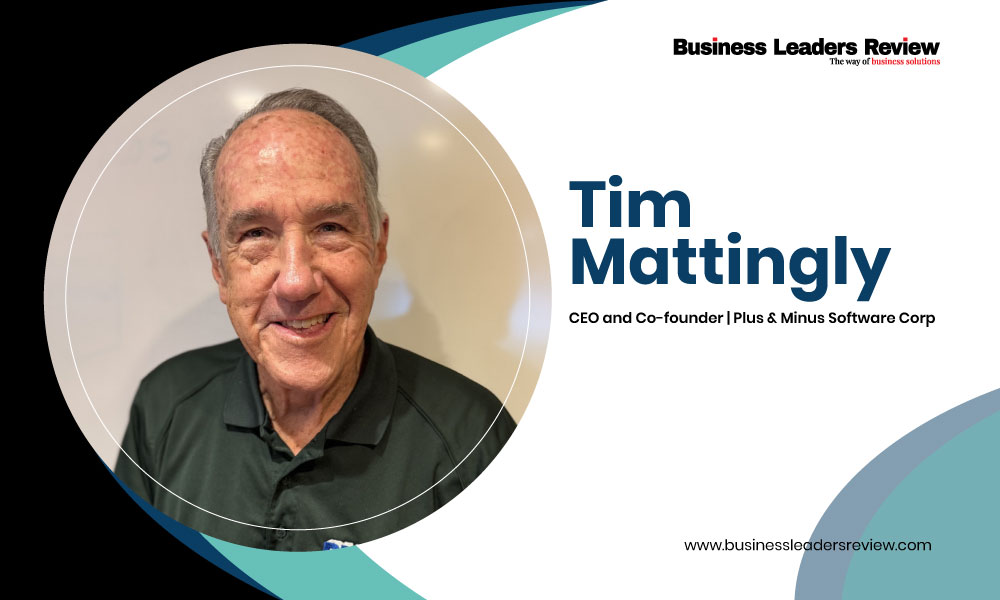
How Tim Mattingly and the Plus & Minus team are challenging ERP complexity with a unified, real-time approach to enterprise management
For decades, enterprise resource planning has been synonymous with complexity. As businesses expand, their software environments often expand with them by the addition of separate systems for accounting, inventory, payroll, job costing, supply chain management, and other functions. While these systems may provide specialised capabilities, they can also create data silos, reconciliation work, delayed reporting, and a growing technology burden.
Plus & Minus Software was built around a fundamentally different idea.
Instead of treating an organization as a collection of disconnected departments and software modules, the company envisioned an ERP in which everything operates within a single, unified environment.
The philosophy was simple: One file. One system. One source of truth.
What began as a bold concept in the early 1980s has evolved into a comprehensive ERP platform supporting accounting, inventory, payroll, job costing, supply chain management, and multi-company consolidations, without abandoning the unified architecture at its core.
Today, under the leadership of Tim Mattingly, CEO and Co-Founder, Plus & Minus continues to demonstrate that simplicity can coexist with sophisticated enterprise functionality.
The Single-File Difference
The origins of Plus & Minus can be traced to a frustration its founders experienced as accountants.
Traditional ERP systems were increasingly being built as collections of modules, with general ledger, accounts payable, accounts receivable, inventory, and payroll operating separately. Every time information moved between these environments, businesses faced the possibility of delays, discrepancies, and reconciliation.
The founders believed there was a better way.
Their answer was a single-file architecture, where financial and operational transactions update the entire system immediately.
That principle remains central to Plus & Minus decades later.
Rather than continually adding disconnected layers, the company has expanded the capabilities of its unified environment while preserving the underlying simplicity.
What Does That Mean for Businesses?
- Real-time data across financial and operational functions
- Reduced reconciliation between departments and systems
- One database to maintain and back up
- One environment for users to work in
- Unified reporting across business functions
- Greater visibility for management
- Lower IT and administrative overhead
The result is an ERP that is designed not merely to record what has happened, but to keep the entire organization synchronised as activity occurs.
From Accounting Software to an Operational Engine
Integration becomes particularly powerful when accounting and operations exist within the same environment.
At Plus & Minus, purchasing can flow into receiving and accounts payable. Inventory movements can immediately influence job costing and financials. Payroll can feed directly into project budgets and cash-flow information.
Instead of departments spending time moving information between systems, the information moves with the business.
This can have a significant impact on financial operations, particularly during month-end and year-end close.
With fewer cross-system reconciliations required, finance teams can spend less time searching for discrepancies and more time analysing the information that supports business decisions.
The ERP becomes more than a record-keeping platform. It becomes an operational engine.
The Power of Real-Time Visibility
Modern businesses cannot afford to make important decisions using outdated information.
Plus & Minus addresses this by posting transactions instantly across its unified environment. Whether the activity involves a shipment, purchase order, payroll run, inventory movement, or job-cost entry, the corresponding information is reflected throughout the system without waiting for batch processing or module synchronisation.
For management teams, this creates a clearer picture of the business at any given moment.
They can:
- Identify emerging trends earlier
- Monitor project profitability
- Track current financial positions
- Recognise operational issues sooner
- Respond to opportunities faster
- Access consolidated information across multiple entities
For multi-company organizations, this becomes particularly valuable. Shared master files, instant consolidations, and unified reporting allow executives to maintain an enterprise-wide view without losing visibility into individual companies.
When Integration Creates Measurable Results
The value of Plus & Minus becomes particularly clear when viewed through the experience of its customers.
One manufacturing client previously operated with a fragmented technology environment that included a standalone inventory system, a separate job-costing solution, and a traditional accounting package.
The consequences were familiar:
- Days spent reconciling data.
- Limited visibility into project costs.
- Reports that took hours to prepare.
- Financial information that was difficult to keep aligned.
After moving to Plus & Minus, inventory movements began updating job costs and financials instantly. Payroll flowed directly into project budgets, while reports that previously required hours of preparation became available in seconds.
The company ultimately shortened its month-end close by nearly 50% and gained real-time visibility into project profitability.
The customer’s description captures the impact particularly well: “Finally being able to run the business instead of chasing the numbers.”
For Plus & Minus, this represents the fundamental purpose of an ERP—to give businesses greater control over their information rather than forcing them to spend their time managing information gaps.
Innovation Without Adding Complexity
ERP technology is evolving rapidly. Automation, cloud computing, APIs, predictive analytics, and intelligent reporting are changing what businesses expect from their enterprise platforms.
Plus & Minus is embracing these developments while remaining disciplined about its core philosophy.
Its expanding capabilities include:
Automated Banking
- ACH
- Positive Pay
- Bank reconciliation
Document & Workflow Support
- Document attachments
- Streamlined approvals
- Improved audit processes
Flexible Deployment
- On-premises operation
- Secure hosted/cloud environments
Future Connectivity
- Expanded API integrations
- Broader third-party connectivity
The objective is not to add technology simply for the sake of adding features.
Every enhancement must work within the unified architecture and contribute to making the platform faster, clearer, more accessible, or more useful.
That discipline helps Plus & Minus avoid one of the most common problems in enterprise software: solving complexity by creating even more complexity.
A Philosophy Built Around Simplicity
Behind the technology is a straightforward design principle.
Every major product decision begins with a simple question:
Does this make the system easier to use?
If the answer is no, the feature does not belong on the roadmap.
This philosophy influences not only product development but also the company’s relationship with customers.
The Plus & Minus team places emphasis on:
- Curiosity
- Accountability
- Collaboration
- Customer empathy
- Continuous improvement
By staying close to users and listening to real-world challenges, the company can evolve the platform without losing the characteristics customers depend upon.
It is a particularly important balance in ERP, a sector where functionality can easily come at the expense of usability.
Why the Unified Model Is Becoming More Relevant
Interestingly, many of the trends shaping the future of ERP are reinforcing principles Plus & Minus adopted decades ago.
Businesses increasingly expect:
- Real-time intelligence: Information must be available when decisions are being made.
- Automation: Manual and repetitive processes are being replaced with automated workflows.
- Cloud flexibility: Organizations want the ability to operate in hosted environments without compromising performance.
- Unified data: Businesses are becoming increasingly aware of the cost and risk created by fragmented information.
- Connected ecosystems: APIs and integrations are becoming essential as businesses connect their ERP environments with other technologies.
Plus & Minus is therefore entering the future with an architecture already aligned with many of these expectations.
2026 & Beyond
Looking toward 2026 and beyond, the company’s focus remains firmly on strengthening what already works.
Its roadmap includes greater automation, expanded cloud capabilities, enhanced dashboards, predictive tools, and broader API connectivity.
But the single-file architecture remains non-negotiable.
The ambition is not necessarily to become the largest ERP provider.
It is to become one of the most dependable.
A platform businesses can trust for clarity, speed, stability, and real-time information without the operational burden traditionally associated with complex ERP environments.
Simplicity as a Strategy
The story of Plus & Minus is ultimately about more than accounting software or ERP architecture.
It is about challenging an assumption that has shaped enterprise technology for decades: that powerful systems must inevitably become complicated.
Plus & Minus has taken a different view.
By bringing accounting, operations, inventory, payroll, job costing, and supply chain management together within a unified environment, the company has built its growth around a simple principle: businesses should not have to work around their software. Their software should work together with the business.
As enterprise technology moves toward greater automation, real-time intelligence, cloud flexibility, and unified data, that philosophy may become even more relevant.
Because sometimes, the most powerful innovation is not adding another layer.
It is removing the layers that never needed to be there.
About Plus & Minus Software
Plus & Minus Software is a unified ERP platform designed to simplify business management through a single-file architecture. Its integrated system brings accounting, inventory, payroll, job costing, supply chain management, and multi-company operations together in one environment, providing real-time visibility and reducing reconciliation, complexity, and IT overhead.
Company Details
- Company Name: Plus & Minus Software Corp.
- Founding Year: 1982
- Office Locations: Houston, Texas
- Official Website: https://plusandminus.com
- Industry/ Sector: Software developer. ERP Accounting Software
Featured Leader’s Profile
- Name of the Featured Leader: Tim Mattingly
- Designation: CEO / Co-founder
- Brief Background & Experience:
Tim has dual degrees in Accounting and Computer Science. He served in the Army Signal Corps, specializing in computing, and was discharged as Captain. Tim spent 7 years in public accounting with PricewaterhouseCoopers and Ernst & Young. Tim subsequently managed manufacturing companies, giving him an insider’s view of accounting applications. His years of experience in both the public accounting and business worlds give him a unique and advantageous perspective. Seamlessly, Tim guides the company’s continual update of the user experience.
Company Highlights
- Key Services/Offerings:
- Plus & Minus delivers a non‑modular, single‑file ERP accounting system that unifies all financial, inventory, and operational data in one place — eliminating the complexity of traditional multi‑module accounting software.
- Real‑Time Financial Visibility: Instant posting across GL, inventory, projects, and supply chain with no reconciliation delays.
- Industry‑Flexible Design: Used in manufacturing, construction, distribution, oil & gas, financial services, and non‑profits.
- Major Achievements or Recognitions:
- Plus & Minus is widely recognized for pioneering a unified, non‑modular ERP accounting architecture and has earned multiple industry accolades for innovation and long‑term impact.
- Tim Mattingly (CEO) — Known for 40+ years of accounting technology innovation and Big Four experience Tom Friedman (Co‑Founder) — Former PwC partner recognized for shaping the original unified‑file architecture.
- AI‑Driven Enhancements — Praised for early integration of AI and APIs to reduce programming and customization costs.